






10 Best Board Games for Language Learning
Learning a language doesn’t have to be boring. Board games can make the process fun, social, and effective. From building vocabulary to improving grammar and communication, these games offer interactive ways to practice. Whether you're a parent, teacher, or self-learner, games like Scrabble, Codenames, and Bananagrams can help you sharpen your skills while having a good time.
Here’s a quick look at the top games for language learning:
- KLOO Language Games: Sentence-building for French, Spanish, Italian, and English learners.
- Scrabble: A classic for expanding vocabulary and spelling skills.
- Dixit: Uses storytelling to enhance creative expression and listening.
- Codenames: Focuses on word association and critical thinking.
- Bananagrams: Fast-paced word-building for vocabulary practice.
- Story Cubes: Encourages storytelling and narrative skills through visual prompts.
- National Geographic Brain Games: Challenges verbal reasoning and communication.
- Zingo! Word Builder: Great for young learners to connect letters and words.
- Spot It!: Quick matching game that strengthens vocabulary and word recognition.
- Apples to Apples: Builds descriptive language and creative thinking.
Each game targets different skills like reading, speaking, or listening and caters to various age groups and proficiency levels. Whether you're learning solo, teaching in a classroom, or playing with family, these games are a fun way to practice and improve.
15+ Board Games to use when Teaching English as a Second Language
How Board Games Help Language Learning
Board games are a fantastic way to develop vocabulary, grammar, and communication skills - all while having fun. Unlike traditional classroom methods, they immerse players in natural contexts where language learning happens organically. Through gameplay, learners pick up new words, practice grammar, and engage in meaningful conversations, blending these elements into a practical and enjoyable experience.
Building Vocabulary Through Play
Games like Scrabble and Bananagrams make expanding vocabulary feel effortless. Players encounter unfamiliar words from their opponents and often look up their meanings on the spot, adding them to their mental word bank. The competitive nature of these games pushes players to recall words quickly, helping cement them in long-term memory.
Encouraging Conversation and Creativity
Certain games naturally spark conversation and storytelling. Take Story Cubes, for example - players create imaginative narratives based on visual prompts, flexing their creative muscles while practicing sentence structure and storytelling. Similarly, Apples to Apples encourages players to explain and justify their word choices, fostering dialogue, negotiation, and deeper language engagement.
Boosting Reading and Listening Skills
Fast-paced games like Blurt!, Headbanz, and Zingo! Word Builder challenge players to process written and verbal clues quickly. This sharpens both reading comprehension and auditory processing, as players must listen carefully and respond in real time.
The Social Advantage
One of the biggest perks of board games is their social nature. Playing in groups encourages collaboration, turn-taking, and teamwork - all essential communication skills. These interactions happen in a relaxed, low-pressure setting, making language practice enjoyable instead of stressful. Plus, the group dynamic often leads to discussions about cultural nuances, adding another layer to the learning experience.
Exploring Cultural Contexts
Some games introduce players to culturally relevant themes and idiomatic expressions. For example, Apples to Apples includes culturally rooted words and references, sparking discussions about their meanings and significance. These moments offer insight into real-world language use that textbooks often miss.
What the Research Says
The benefits of board games for language learning aren’t just anecdotal - they’re backed by research. A 2021 study in the Journal of Educational Psychology found that students who played language-based board games for just 30 minutes a week retained 25% more vocabulary than those who relied solely on textbooks. Similarly, a 2022 survey by the American Association of Teachers of Foreign Languages revealed that 78% of educators reported better student engagement and retention when games were part of the curriculum.
Tailored to Any Skill Level
Board games are incredibly flexible, making them suitable for learners of all ages and proficiency levels. Younger children might enjoy simpler games like Zingo! Word Builder, while advanced learners can tackle more complex options like Codenames or Dixit. Teachers and parents can tweak the rules to emphasize specific skills, such as forming full sentences or crafting detailed stories.
Real-Life Success Stories
Case studies highlight the effectiveness of board games in language learning. For instance:
In a 2020 study by the University of Cambridge, elementary school students in the UK played KLOO twice a week for 20 minutes over 12 weeks. By the end of the study, these students demonstrated a 30% improvement in constructing sentences in French and a 20% increase in vocabulary retention compared to a control group using only textbooks.
Motivation Through Fun
What makes board games so effective is their ability to keep learners engaged. Points, winning rounds, and the unpredictability of cards or dice create an exciting environment where players want to keep coming back. This repetition, paired with immediate feedback, reinforces language skills in a way that feels less like work and more like play.
Even speech therapists have tapped into the power of board games like Bananagrams and Apples to Apples. These games help clients improve word retrieval and categorization, with therapists reporting noticeable gains in expressive language skills. The authentic, real-world scenarios created during gameplay make it easier for learners to retain and apply these skills outside the game.
1. KLOO Language Games
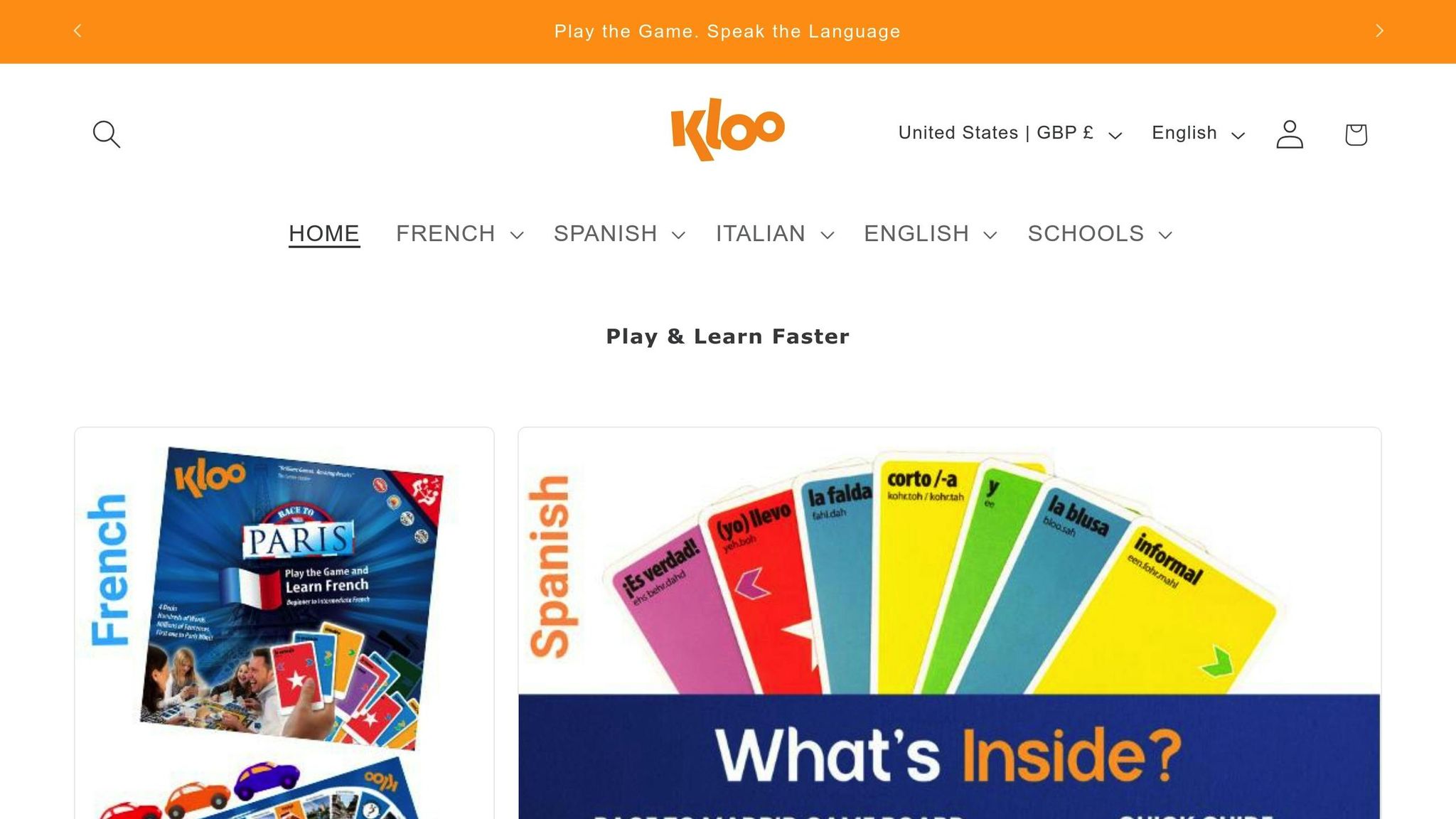
KLOO Language Games is an award-winning board game that takes a fresh approach to language learning. Instead of relying on traditional flashcards, it uses a color-coded system to guide players in building sentences while naturally expanding their vocabulary and understanding grammar. Recognized as the "Best Board Game of the Year" in language learning, KLOO has earned praise from educators for its hands-on, discovery-based learning style.
What sets KLOO apart is how it mirrors the process of learning a first language. Players draw cards and arrange them into sentences, with the color-coded design representing different parts of speech. This intuitive system helps learners grasp sentence structure and word order without needing to memorize complicated grammar rules.
The game’s sentence-building mechanics combine grammar and vocabulary learning with a competitive edge. Players earn points by creating longer or more complex sentences, making the process both engaging and confidence-boosting.
KLOO also offers themed decks like "On the Go", "Food & Drink", and "Places & Travel", allowing learners to focus on practical, real-world vocabulary. These themes make the experience more relevant and enjoyable for players.
Supported Languages
KLOO Language Games are available in French, Spanish, Italian, and English (for ESL learners). Each version is carefully designed to reflect the unique grammar and vocabulary of the target language, ensuring an authentic learning experience for both beginners and intermediate learners.
Primary Language Skills Targeted
The game emphasizes reading and speaking skills through its sentence-building gameplay. Players expand their vocabulary and improve their grammar by arranging the color-coded cards into sentences. Additionally, the inclusion of pronunciation guides helps with speaking practice, and reading sentences aloud provides incidental listening opportunities.
Recommended Age Range
KLOO is designed for learners ages 7 and up, making it suitable for kids, teens, and adults. Its adaptable difficulty levels make it perfect for family game nights, classroom settings, or adult learning groups.
Player Count
The game supports 2 to 4 players in its standard format but also allows for solo practice or larger group play by forming teams. This flexibility makes KLOO a great choice for small gatherings, classrooms, or even individual learners. Up next, we’ll dive into another game that turns language learning into a fun challenge.
Scrabble
Scrabble stands as a classic word game that has delighted players for generations while helping to expand vocabulary. Using letter tiles on a crossword-style board, players are challenged to create words, making it a fun way to sharpen spelling skills and improve word recognition. In fact, regular play has been shown to enhance vocabulary retention, with studies reporting up to a 20% improvement among language learners.
What makes Scrabble even more engaging is its competitive edge. Players must think strategically about how to use their letters effectively, all while connecting their words to those already on the board. This format reinforces spelling and word-building through visual connections, adding an educational twist to the fun.
Supported Languages
Scrabble isn’t just for English speakers - it’s available in a variety of languages. Official editions exist for Spanish, French, German, Italian, and more, with each version carefully adjusted to reflect the unique letter distributions and scoring systems of the language it represents.
Skills It Develops
The game is a powerhouse for language skills. Scrabble helps players enhance reading and writing abilities as they recognize, spell, and construct words from their tiles. In group settings, the game also promotes speaking and listening skills, as players discuss word meanings and negotiate rules.
Age Recommendations
Scrabble is ideal for players aged 8 and older. For younger children, Scrabble Junior offers a simplified version with easier rules and a double-sided board to cater to varying skill levels. This version is perfect for kids as young as 5 or 6.
Number of Players
The standard game supports 2–4 players, but it can easily be adapted for group or classroom settings. Team play adds a collaborative element, encouraging communication and teamwork.
3. Dixit
Dixit takes a fresh approach to language learning by combining creative storytelling with imaginative gameplay. This award-winning game uses beautifully illustrated cards to inspire players to express abstract ideas and interpret others' descriptions. Unlike traditional language games that focus on memorization or spelling, Dixit challenges players to think outside the box, making it an engaging way to develop conversational skills.
Here’s how it works: one player becomes the storyteller, choosing a card from their hand and giving a clue - this could be a single word, a phrase, or even a sentence. The other players then pick cards from their hands that they think match the storyteller’s clue. Once all the cards are revealed, everyone votes on which card they believe belongs to the storyteller. This process naturally encourages the use of descriptive language while sharpening listening skills, as players must interpret nuanced clues and communicate their thoughts effectively. The game’s open-ended nature makes it a fun and effective way to practice language through creative expression.
What sets Dixit apart for language learners is its versatility. The stunning artwork on each card invites endless interpretations, allowing players to stretch their imaginations. This flexibility has contributed to the game’s popularity - it has sold over 1.5 million copies and won the prestigious Spiel des Jahres award in 2010.
Supported Languages
One of Dixit’s standout features is its universal design. The game doesn’t rely on any specific language, making it ideal for learners of English, Spanish, French, German, or virtually any other language. The visual prompts provided by the cards allow players to communicate regardless of their language proficiency, and the game is available in over 30 languages worldwide.
Primary Language Skills Targeted
Dixit primarily focuses on developing speaking and listening skills. Players practice articulating their thoughts clearly when giving clues and hone their listening abilities as they interpret others’ descriptions. While some educators adapt the game to include reading or writing exercises - like jotting down clues - the real strength of Dixit lies in encouraging verbal communication and sparking creativity.
Recommended Age Range
Dixit is designed for players aged 8 and up, making it a fantastic choice for both kids and adults. Its simple mechanics and imaginative gameplay appeal to a wide variety of age groups, whether in family gatherings, classrooms, or adult learning settings. The game’s creative format also helps ease speaking anxiety, making it especially useful for shy or hesitant learners.
Player Count
Dixit works best with 3 to 6 players, with 4 to 6 being the ideal range. This ensures that everyone gets plenty of opportunities to speak and listen without the game dragging on or becoming too chaotic. In classroom settings, the game can be adapted for larger groups by forming teams or rotating players between rounds, ensuring everyone stays engaged.
4. Codenames
Codenames blends word association with strategy, dividing players into two teams led by spymasters. Each spymaster gives one-word clues to guide teammates in identifying secret agents on a grid of word cards. This setup pushes players to think critically about how words connect and the multiple meanings they can carry. Its mechanics make it a fantastic tool for practicing language skills in a fun and engaging way.
Spymasters must craft clues that link several terms, prompting teammates to discuss and deduce the correct words. This interaction fosters concise speaking and active listening, offering a natural way to practice communication skills in a goal-driven environment.
But it’s not just about vocabulary. Codenames encourages higher-level thinking by challenging players to identify subtle connections and reason creatively. The mix of competition and teamwork makes it appealing for everyone, including those who might be hesitant to speak up.
Supported Languages
Codenames has been released in many language editions, making it accessible to learners of Spanish, French, German, Italian, Portuguese, Russian, Polish, Dutch, and more. Each version is tailored with vocabulary that reflects the language's nuances and context, ensuring learners engage with authentic terms. While the vocabulary changes, the core gameplay stays consistent, delivering the same language-learning benefits across all editions.
Primary Language Skills Targeted
This game strengthens essential language skills in several ways. Players practice speaking and listening as they exchange clues and discuss strategies. Reading the word cards enhances reading comprehension, while the need to analyze word relationships boosts semantic awareness and inferential thinking. These aspects make Codenames an excellent tool for practicing advanced language concepts.
Recommended Age Range
Codenames is designed for players aged 10 and up, though its suitability depends more on vocabulary knowledge than age. Adult learners can dive into the standard version, while younger players or beginners might find Codenames: Pictures more approachable, as it uses images instead of words to simplify gameplay.
Player Count
The game works best with 4–6 players but can accommodate anywhere from 2 to 8 or more. For team-based play, at least 4 players are needed, with one spymaster per team. In classrooms or larger groups, multiple teams can be formed, or players can rotate roles, making Codenames a flexible choice for various learning settings.
5. Bananagrams
Bananagrams turns word-building into a fast-paced challenge where players race to create their own crossword-style grids using letter tiles. Unlike traditional board games, it gives players the freedom to independently form interconnected words as quickly as they can. The objective? Use up all your tiles first by building a valid word grid.
What makes Bananagrams stand out for language learners is its interactive and energetic approach to vocabulary practice. Players are constantly rearranging and modifying their word grids, which naturally encourages experimentation with letter combinations and word patterns - all while racing against the clock.
Its portability is another big plus. Packed in a banana-shaped pouch, it’s easy to carry to classrooms, study groups, or anywhere else learners want to sharpen their skills. There’s no lengthy setup, no complex rules, and no waiting for turns - just instant, hands-on engagement with letters and words. Let’s take a closer look at the language skills this game helps to develop.
Primary Language Skills Targeted
Bananagrams is particularly effective at building reading and writing skills through active word creation. Players must quickly spot letter patterns, form valid words, and arrange them into connected grids. These activities directly improve spelling and help learners retain new vocabulary.
Teachers can add a verbal element to the game by asking players to read their words aloud or explain their choices. Some educators even challenge students to define unfamiliar words they’ve created, turning each round into a mini vocabulary lesson.
The game’s focus on speed and accuracy also boosts automatic word recognition, a key component of reading fluency. As players become more familiar with common letter combinations and word structures, their ability to process language improves overall.
Supported Languages
Bananagrams works with any language that uses the Roman alphabet, making it a versatile tool for language learning. While the standard version is designed for English, there are language-specific editions for Spanish, French, and German, which adjust tile distributions to reflect the frequency of letters in each language.
For languages without dedicated editions, players can easily adapt the standard set by focusing on vocabulary from their target language. This flexibility allows learners of English, Spanish, French, or other languages to use the game to practice spelling, expand vocabulary, and improve word recognition.
Recommended Age Range
Bananagrams is suitable for players aged 7 and up. Younger participants benefit from the tactile experience of handling letter tiles, while older players enjoy the strategic aspect of building efficient word grids.
For language learners, the game’s usefulness depends more on vocabulary level than age. Adult beginners often find it just as engaging and helpful as younger native speakers, making it a great choice for mixed-age learning environments.
Player Count
The game accommodates 1 to 8 players, offering flexibility for various learning setups. Solo play is excellent for language learners who want to practice at their own pace, while group games of 2-8 players create a lively, competitive atmosphere that encourages quick thinking and faster word recall.
In classroom settings, multiple games can run simultaneously in small groups. This adaptability makes Bananagrams ideal for individual study, small tutoring sessions, or full-class activities, all without needing extra materials or rule changes.
6. Story Cubes
Story Cubes turns storytelling into a fun and interactive way to learn languages - all with a simple roll of nine dice. Each die has six unique images, and players use the rolled images to craft imaginative stories, connecting the visuals into coherent narratives.
This game is a favorite among educators because it’s open-ended - there’s no “right” or “wrong” answer. That flexibility takes the pressure off, making language learning less stressful. Instead of worrying about grammar or pronunciation, players focus on expressing their thoughts and weaving creative tales.
The visual prompts are easy to understand, no matter the language. Whether you’re learning English, Spanish, French, German, or something else, the image-based design ensures anyone can dive in, regardless of their language level.
Primary Language Skills Targeted
Story Cubes is great for developing speaking and listening skills. Players practice telling concise, organized stories, which helps them learn how to structure their thoughts. It’s also a fantastic tool for narrative development, often recommended by educators and speech-language pathologists to strengthen storytelling and expressive language abilities.
Teachers can even use Story Cubes for writing exercises. For example, students can write short stories or dialogues based on the dice images, making it a well-rounded resource for language learning.
Supported Languages
Because the dice only feature pictures and no text, Story Cubes works for any language. This makes it a perfect fit for multilingual classrooms, family game nights, or solo practice sessions. Its language-neutral design offers broad appeal, breaking down barriers for learners of all linguistic backgrounds.
The game is available in over 50 countries, with packaging translated into multiple languages. This ensures it’s accessible to learners from diverse regions and backgrounds.
Recommended Age Range
Story Cubes is designed for players aged 6 and up. Its simple rules and engaging visuals make it ideal for kids, but the open-ended nature keeps it interesting for teens and adults, too. In language learning, the game’s impact depends more on a learner’s vocabulary and comfort with communication than their age, making it an excellent choice for mixed-age groups.
Player Count
Whether you’re playing alone or with a group, Story Cubes adapts to your needs. Solo play gives learners a chance to build confidence in a low-pressure setting, while group play encourages collaboration and the exchange of ideas. In classrooms, teachers can organize small groups or involve the entire class in storytelling activities, making it a flexible tool for language practice.
This versatile storytelling game fits seamlessly into any language-learning toolkit, offering a creative way to practice both individually and in groups. Up next, discover a game that puts your word association skills to the test!
sbb-itb-1ed942f
7. National Geographic Brain Games
National Geographic Brain Games is a fun and engaging cognitive challenge game that revolves around puzzles and activities aimed at boosting verbal reasoning and communication. While it’s not specifically created as a language learning tool, it offers plenty of opportunities to develop language skills by focusing on verbal reasoning, word associations, and communication tasks.
Players are often tasked with explaining concepts, describing images, and solving word-based puzzles - all of which naturally enhance speaking and listening abilities. By encouraging participants to articulate their thought processes and explanations, the game creates an enjoyable and low-pressure environment for language practice. This makes it a great fit for learners who thrive on content-based activities that promote language use.
Primary Language Skills Targeted
This game primarily strengthens reading and listening skills through trivia questions, puzzles, and challenges that require players to process clues and respond verbally. It also encourages speaking, as players discuss answers, share their reasoning, and collaborate during challenges. Unlike traditional word games that focus on spelling or word-building, it emphasizes general knowledge, reading comprehension, and listening skills. This makes it particularly useful for intermediate and advanced learners aiming to expand their vocabulary and comprehension in a more dynamic way.
Recommended Age Range
National Geographic Brain Games is designed for players aged 8 and up. Its balance of accessibility and challenge makes it ideal for family game nights or educational settings, offering something enjoyable for a wide range of ages.
Player Count
The game supports 2 or more players and often encourages team play, fostering social interaction and collaboration. It’s a perfect fit for classrooms, where teachers can organize team-based activities, or for family settings, where everyone can join in the brain-teasing fun.
8. Zingo! Word Builder
Zingo! Word Builder turns language practice into an exciting bingo-style game for young learners. Created by ThinkFun, this game blends picture and word cards in a fast-paced activity that helps children build early literacy skills through play.
At the heart of the game is the "zinger" slider mechanism, which randomly reveals letter combinations. This surprise element keeps kids engaged as they race to form words using the letters on their cards. It’s a fun way to sharpen visual recognition, quick thinking, and vocabulary recall.
Players match word cards to images on their boards, reinforcing spelling and word recognition. This visual pairing of pictures with written words is especially helpful for kids just starting to connect spoken language to text.
With a 4.7-star rating on Amazon (2023) from over 1,500 reviews, Zingo! Word Builder is a favorite among parents and educators.
Primary Language Skills Targeted
Zingo! Word Builder focuses on three important language skills for early literacy:
- Reading: Kids practice recognizing letter patterns and spotting complete words on the game board.
- Writing: Claiming or marking words reinforces spelling patterns and helps develop awareness of how letters form words.
- Vocabulary: The game exposes players to a variety of letter combinations, encouraging them to quickly form words, boosting reading fluency and cognitive speed.
Recommended Age Range
This game is designed for children ages 4 and up, making it a great fit for preschoolers and early elementary students. It’s perfect for introducing letters and words to younger kids while still challenging older ones as they grow.
The game’s adjustable difficulty keeps it engaging for all skill levels. Younger kids can focus on simpler words at their own pace, while older players can enjoy a more competitive, fast-paced experience that sharpens their vocabulary and word recognition skills.
Player Count
Zingo! Word Builder supports 2 to 4 players, making it ideal for small groups, whether at home, in the classroom, or during family game nights. This setup ensures everyone stays involved, with minimal downtime between turns, keeping the energy high.
Playing in a group also encourages turn-taking, teamwork, and problem-solving. Kids can help each other recognize words and share tips, adding a social layer to the learning experience. This combination of fun and education makes it a go-to choice for interactive language practice.
9. Spot It!
Spot It! turns a simple card game into an engaging tool for language practice. The challenge? Spot the one matching symbol between two cards as quickly as possible. This fast-paced game naturally builds vocabulary and sharpens quick word recognition skills.
Its straightforward gameplay allows for creative twists - like requiring players to say the word in their target language when spotting a match. This makes it a favorite among educators and speech-language pathologists for enhancing both expressive and receptive language abilities. Plus, its visual focus creates a relaxed setting where learners can build vocabulary without worrying about tricky grammar rules.
With over 30,000 reviews and a 4.8-star rating on Amazon, Spot It! has earned its reputation as both a fun family game and an effective educational tool. Teachers and parents love how it keeps kids engaged while reinforcing new words.
Supported Languages
Spot It! comes in various editions tailored to different languages, making it accessible to a wide range of learners. While the standard version is available in English, you’ll also find editions in Spanish, French, and German. Each version features vocabulary and symbols specific to the language, offering an immersive experience.
For instance, the "Spot It! Spanish" edition uses Spanish words and culturally relevant images, helping learners practice without needing to translate. These language-specific editions make it easier for players to dive straight into their target language.
By blending language-specific content with customizable gameplay, Spot It! fits seamlessly into any language learning routine.
Primary Language Skills Targeted
Spot It! is designed to boost key language skills in a dynamic way. The game primarily focuses on speaking and listening. Players must quickly identify and call out matching symbols, which helps improve word retrieval, pronunciation, and confidence in speaking.
For editions that include words, the game also enhances reading skills. Players practice recognizing and reading words aloud, which strengthens the connection between written and spoken language. This combination of visual cues and verbal interaction makes learning feel natural and intuitive.
While writing isn’t part of the standard gameplay, creative parents and teachers often add their own twists. For example, players might write sentences using matched words after a round, extending the learning experience beyond the game.
Recommended Age Range
Spot It! is suitable for players ages 6 and up, offering fun and learning for kids and adults alike. The standard version provides enough challenge for all ages, making it ideal for family game nights or classroom activities.
For younger learners, the "Spot It! Jr. Animals" edition is perfect for children as young as 4 years old. This version simplifies the gameplay with fewer symbols and easier images, ensuring that even the youngest players can join in while still practicing language skills.
The game’s adaptable difficulty makes it a great fit for everyone. Beginners can focus on basic vocabulary, while advanced players can add extra challenges, like creating sentences or translating words.
Player Count
Spot It! works with 2 to 8 players, making it versatile for small or large groups. Whether it’s a family gathering or a classroom setting, the game encourages social interaction and natural conversation. Players often help each other identify words and share tips, adding a collaborative element to the learning process.
With its mix of fun, learning, and adaptability, Spot It! proves to be more than just a game - it’s a language-learning tool that brings people together.
10. Apples to Apples
Apples to Apples turns word association into an engaging way to boost language skills. The game involves matching noun cards to adjective cards and explaining why the pairing works. This simple yet interactive approach not only expands vocabulary but also encourages players to think creatively about how words relate to one another.
What makes this game stand out is its open-ended nature - there’s no single “right” answer. This takes the pressure off and lets players focus on crafting convincing explanations and exploring different interpretations. Language teachers often recommend Apples to Apples for practicing parts of speech, descriptive language, and creative thinking, whether in classrooms or at home.
With more than 10,000 reviews and a 4.8-star rating on Amazon, the game has earned a reputation as both a fun party activity and a valuable educational resource. Educators and speech-language pathologists frequently call it a “must-have” for group activities aimed at building language skills.
Supported Languages
While Apples to Apples is primarily available in English, making it a favorite for language learners in the U.S., localized versions are also offered in Spanish, French, and German. These editions adapt vocabulary and references to suit their specific audiences, creating a more relatable learning experience in those languages[1,9]. However, the standard English edition remains the most extensive, exposing players to a wide variety of commonly used American English terms.
Primary Language Skills Targeted
Apples to Apples strengthens multiple language skills. Speaking and listening get a workout as players justify their card choices and engage with others’ arguments. Reading also plays a key role since players need to interpret the cards to form logical connections. Some educators even adapt the game to include writing exercises, such as having players write explanations or short stories based on their card combinations[1,2].
Recommended Age Range
The standard version of Apples to Apples is ideal for players aged 12 and up, catering to teens and adults who can handle more advanced vocabulary and abstract ideas. For younger players, there’s Apples to Apples Junior, designed for kids aged 9 and up, with some editions suitable for children as young as 7. Both versions encourage multi-generational play, making them a favorite for family game nights and classroom activities alike.
Player Count
The game works for groups of 4 to 10 players, with 6–8 being the sweet spot for the best language practice opportunities. This flexibility is especially useful in classrooms, where teachers can divide students into smaller groups. Rotating the role of judge ensures everyone gets a chance to express their ideas and evaluate others’ reasoning - a balanced way to develop both expressive and receptive language skills.
Game Comparison Table
This table highlights key details - like language, age range, player count, skills, and playtime - to help you pick the perfect board game for enhancing language skills.
| Game | Supported Languages | Age Range | Player Count | Language Skills | Average Playtime | Purchase Link |
|---|---|---|---|---|---|---|
| KLOO Language Games | English, Spanish, French, Italian | Ages 6+ | 2–4 players | Vocabulary, sentence construction, grammar | 20–30 minutes | Brain-Games.lv/en/ |
| Scrabble | English and many other languages | Ages 8+ | 2–4 players | Vocabulary, spelling | 45–60 minutes | Brain-Games.lv/en/ |
| Dixit | Language-independent (multilingual rulebooks) | Ages 8+ | 3–6 players | Storytelling, descriptive language, listening | 30 minutes | Brain-Games.lv/en/ |
| Codenames | English and several other languages | Ages 10+ | 2–8+ players | Word association, deduction, speaking, listening | 15–30 minutes | Brain-Games.lv/en/ |
| Bananagrams | English (other language editions available) | Ages 7+ | 1–8 players | Vocabulary, spelling, word formation | 15–30 minutes | Brain-Games.lv/en/ |
| Story Cubes | Language-independent | Ages 6+ | 1+ players | Storytelling, narrative skills, creativity | 10–20 minutes | Brain-Games.lv/en/ |
| National Geographic Brain Games | English | Ages 8+ | 2–6 players | Vocabulary, general language skills | 30–45 minutes | Brain-Games.com |
| Zingo! Word Builder | English | Ages 5+ | 2–6 players | Spelling, word recognition | 10–20 minutes | Brain-Games.lv/en/ |
| Spot It! | Language-independent (English editions available) | Ages 6+ | 2–8 players | Vocabulary, quick thinking | 10–15 minutes | Brain-Games.lv/en/ |
| Apples to Apples | English (Spanish, French, German editions available) | Ages 12+ | 4–10+ players | Word association, descriptive language, parts of speech | 30–45 minutes | Brain-Games.lv/en/ |
Quick Selection Guide: If you're working with beginners or younger kids, games like Zingo! Word Builder or Story Cubes are excellent choices. For learners with more experience, KLOO Language Games or Bananagrams offer a bit more challenge. Advanced learners will enjoy the depth of Codenames or Apples to Apples.
Short games like Spot It! (10–15 minutes) are great for quick warm-ups, while longer games such as Scrabble (45–60 minutes) allow for more in-depth vocabulary practice. Games like Dixit and Story Cubes, which don’t rely on specific languages, are ideal for mixed-language groups or visual learners.
For classroom settings, flexible options like Codenames (2–8+ players) and Apples to Apples (4–10+ players) can fit various group sizes. Family game nights are well-suited to age-friendly games, including junior versions of Scrabble and Apples to Apples.
All links lead to Brain-Games.lv/en/ or Brain-Games.com, ensuring access to reliable, authentic products.
Up next, discover strategies to get the most out of these board games as language learning tools.
Tips for Better Language Learning with Board Games
Board games can be a fantastic tool for language learning, offering a fun and interactive way to practice. Whether you're a parent, teacher, or learning on your own, these tips can help you make the most of your game sessions and turn them into powerful language-learning experiences.
Customize Rules to Encourage Language Use
One of the best things about board games is how adaptable they are. You can tweak the rules to fit your language-learning goals. For younger players, try requiring complete sentences when using new words. Games like Scrabble or Bananagrams can go beyond spelling practice - ask players to use each word they play in a sentence. This small adjustment turns a simple word game into a more comprehensive language activity.
For more advanced learners, you can up the challenge by incorporating idioms, synonyms, or even creating questions with the words drawn during the game. Teachers might add time limits to encourage quick thinking in the target language. Games like Apples to Apples can also be adapted - players can explain their card choices or defend their answers, which not only sparks creativity but also encourages more complex language use.
Make Games Part of Your Routine
Consistency is key when it comes to language learning. Once you've adjusted the rules to suit your needs, try incorporating board games into your regular study schedule. Weekly or bi-weekly sessions work well, providing a fun break from traditional study methods. Teachers often use games as warm-ups to get students talking or as a wrap-up activity to reinforce new vocabulary and grammar concepts.
For self-learners, games can be a great way to set small, achievable goals, like practicing a specific grammar structure or learning a handful of new words during each session. Families can benefit too - rotating games keeps things interesting and ensures practice across a range of skills, from speaking and listening to reading and writing. This variety helps keep motivation high and the learning process enjoyable.
Use Post-Game Discussions to Reinforce Learning
The learning doesn’t have to stop when the game ends. Post-game discussions are a great way to review vocabulary and solidify language concepts. After playing, have everyone talk about their strategies, share new words they learned, or recount highlights from the game - all in the target language. Teachers can guide these conversations with questions like, "What new words did you learn today?" or "Why did you make that choice?" Families might take turns summarizing the game or creating a story using elements from the session. For example, with Story Cubes, players can retell their stories or invent new ones using the same prompts, which helps build narrative skills while encouraging creativity.
Work with Mixed-Ability Groups
If your group includes learners at different levels, you can still make board games work for everyone. Pair stronger and weaker players, assigning roles like "word checker" or "storyteller" to ensure everyone stays involved. Cooperative games, where the group works together toward a shared goal, are especially effective for mixed-ability groups. Beginners can use tools like dictionaries, while advanced learners take on extra challenges. This setup not only keeps everyone engaged but also turns mistakes into valuable learning moments.
Keep Motivation High Over Time
To maintain interest, keep things fresh by rotating games and introducing new challenges. You can even create recognition systems, like awarding a "word of the week" or celebrating progress with small milestones. Giving learners the chance to choose games or come up with their own house rules can also boost their sense of ownership, making them more invested in the process. These little adjustments can go a long way in keeping the learning experience enjoyable and rewarding.
Research highlights the benefits of board games for language learning - they encourage active participation, repetition, and real-world communication. By making games a regular part of your study plan, you’ll likely see better vocabulary retention, increased confidence, and a greater willingness to engage in conversation compared to more traditional study methods.
Conclusion
Board games bring a refreshing twist to language learning, transforming what might feel like dull study sessions into lively and interactive play. The ten games highlighted here demonstrate how activities like building vocabulary, practicing spelling, and improving communication skills can happen naturally as part of the fun. Whether you're diving into Scrabble's word challenges, exploring KLOO's sentence-building mechanics, or crafting imaginative tales with Story Cubes, these games make language learning feel effortless and enjoyable.
By creating a relaxed and interactive setting, board games help ease the stress often associated with traditional language learning. This low-pressure environment encourages learners to experiment with new words and phrases, boosting confidence along the way. Their flexibility makes them a great tool for parents guiding their children, teachers looking to energize their classrooms, or adults seeking a more dynamic way to practice. Plus, the social aspect of playing together encourages natural conversation and helps learners immediately apply what they've picked up, making it more likely to stick than rote memorization.
To get started, pick a game or two that aligns with your interests and current skill level. You can explore Brain Games-published titles at Brain-Games.com or browse a wider selection at Brain-Games.lv/en/. Set aside time for weekly game nights and watch your language skills grow through fun, engaging, and social play.
FAQs
How do I pick the right board game for my language learning level?
When picking a board game to help with language learning, consider your current language skills and how challenging the game is. Choose games with straightforward instructions and vocabulary that align with your proficiency level. If you're just starting out, easier family games can be a great choice. On the other hand, if you're more advanced, you might enjoy diving into more intricate strategy games. Brain Games provides a variety of options tailored to different skill levels and interests, making it simpler to find one that complements your learning goals.
How can I use board games to improve my language learning?
Board games offer an engaging and interactive way to boost your language skills. To make the most of them, consider these tips:
- Play with native speakers whenever you can. This not only helps you practice but also exposes you to natural phrases and expressions.
- Choose games with plenty of text or verbal interaction, like word games, trivia, or storytelling-based options. These encourage you to actively use the language.
- Learn the rules in the target language. This process introduces you to new vocabulary and phrases in a practical context.
The secret? Make it a habit. Regularly playing language-rich board games turns learning into a fun and collaborative experience rather than just another study session.
Are board games effective tools for adults learning a new language, or are they mainly designed for kids?
Board games offer a fantastic way to learn a new language, appealing to both adults and kids alike. Their interactive nature and engaging formats make them a great fit for learners across different age groups and skill levels.
For adults, these games create a relaxed and enjoyable environment to practice vocabulary, grammar, and conversational skills. They encourage active involvement, which not only strengthens language retention but also makes the learning process feel less like a chore and more like a social activity.
